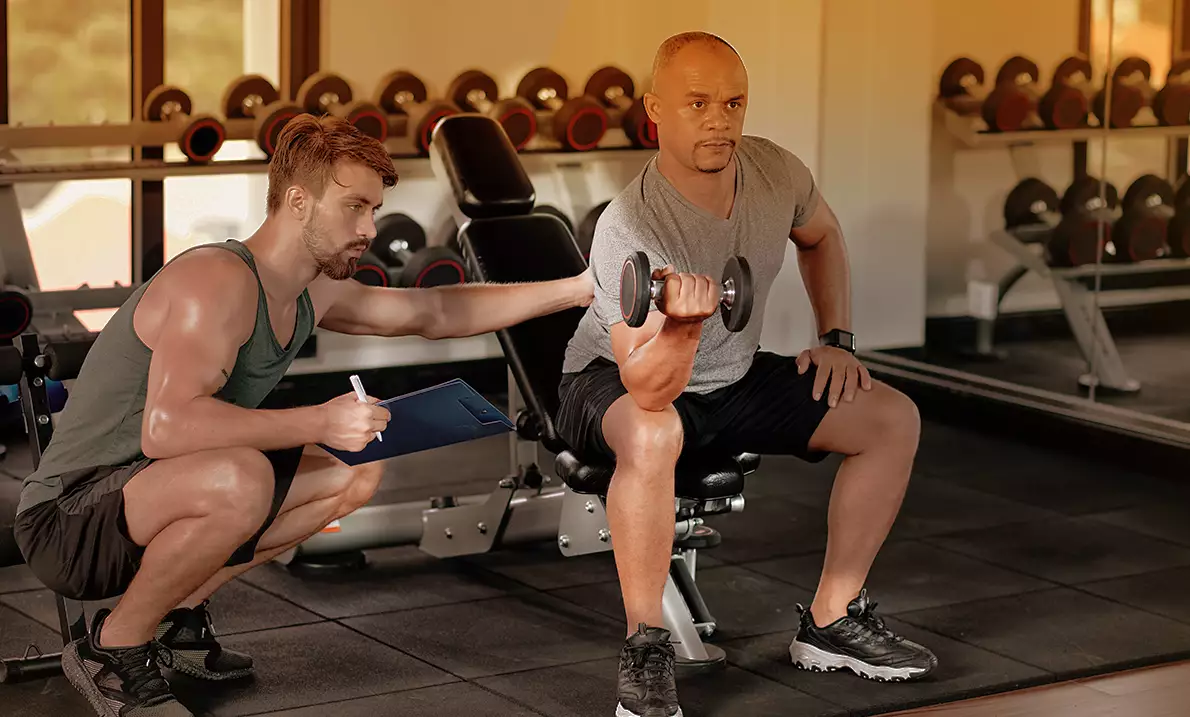
For most people, one to three personal training sessions a week is enough to make progress. The right number depends on your goal, your training experience, what you do between sessions and how well you recover. A beginner learning technique often gets the most from two supervised sessions a week; someone who already trains independently may need only one, for programming and accountability.
The distinction that matters, and the one most guides miss, is that the number of PT sessions is not the same as the number of workouts you need each week. A week of training could be:
- 1 PT session + 2 independent workouts
- 2 PT sessions + walking or cardio
- 3 supervised sessions
- 1 PT session + fitness classes
Each of those is three or more exercise sessions, with very different levels of supervision. So the better question is not “how many times do I need a personal trainer?” but “how much of my weekly training actually needs to be supervised?” That is the question this guide answers.
How many personal training sessions a week do you need?
Between one and three. Beginners and people who struggle to train alone sit at the higher end; experienced gym users who follow a programme independently sit at the lower end. Weekly totals should include the exercise you do without a trainer, not just the sessions you pay for.
| Situation | PT sessions per week | Other training | Main reason |
| Complete beginner | 1 to 2 | Walking or light activity | Technique, confidence and routine |
| General fitness | 1 to 2 | 1 to 2 independent sessions | Consistency and progression |
| Weight loss | 1 to 3 | Steps, cardio and/or independent exercise | Higher weekly activity plus accountability |
| Strength | 1 to 3 | Additional programmed strength work where appropriate | Progressive overload |
| Muscle gain | 2 to 3 | Structured resistance training | Sufficient training volume |
| Returning after a break | 1 to 2 | Low-intensity activity | Gradual return |
| Experienced gym-goer | 1 | 2 to 4 independent workouts | Programming and technique refinement |
| Busy professional | 1 to 2 | Short independent workouts | Sustainable schedule |
These are practical starting frameworks, not guarantees. Goals, age, training history, recovery, injuries, sleep, nutrition and lifestyle all change the appropriate frequency, which is why a good trainer adjusts it after the first few weeks rather than fixing it at the start.
Is one personal training session a week enough?
Yes, one personal training session a week can be enough, provided you follow your programme between sessions. The PT session becomes the anchor of the week: technique is checked, the programme is progressed, and the other workouts happen on your own.
Once-weekly PT works particularly well when:
- You already exercise independently.
- You understand the basic gym movements.
- You need accountability more than constant supervision.
- Your trainer gives you workouts for the other days.
- Your main requirement is programme progression.
- Your budget or schedule limits supervised training.
What a once-a-week PT plan could look like
| Day | Activity |
| Monday | PT strength session |
| Tuesday | Walking or recovery |
| Wednesday | Independent workout |
| Thursday | Rest |
| Friday | Independent workout or fitness class |
| Saturday | Walking or recreational activity |
| Sunday | Rest |
That is three structured sessions a week, with one of them supervised. One session is not automatically sufficient for everyone; if the independent workouts do not happen, the plan collapses to one workout a week, and no single session does much on its own.
Are two personal training sessions a week enough to see results?
For most beginners and recreational gym members, yes. Two sessions a week gives repeated exposure to exercise technique, progressive resistance, programme structure, accountability and regular trainer feedback, without requiring you to be in the gym every day.
The practical advantage is the gap. With one session, a week passes between corrections, and a small technique fault has seven days to settle in. With two, the trainer sees you every three or four days, which is often enough to fix things before they become habits, and it leaves room for one or two independent sessions or a class in between.
Who may benefit most from twice-weekly PT?
- Beginners learning the basic lifts for the first time
- People returning after months or years away from training
- Anyone who lacks confidence on the gym floor
- People learning strength exercises such as squats, deadlifts and presses
- Those who find it difficult to train independently
- Busy London professionals who want two fixed appointments rather than a vague intention
Results from two sessions a week depend on the rest of the week: sleep, food, daily movement, and whether the sessions are actually attended. Two sessions reliably done for three months beat four sessions planned and half attended.
What about three personal training sessions a week?
Three sessions a week means most of your training is supervised. That is a substantial amount of coaching, and it is not automatically better than two.
Three sessions make sense when:
- Most of your workouts will be supervised anyway.
- You are new and want more coaching, not less.
- You have a structured short-term goal with a deadline.
- Technique needs close monitoring, for instance after time away.
- Accountability is the main barrier, and a booked appointment is what gets you there.
- The programme distributes training sensibly across the week rather than stacking hard sessions.
More PT sessions do not automatically mean faster results
Training creates the stimulus for adaptation. Recovery allows the body to respond.
Three hard sessions on consecutive days, on poor sleep, with a physical job and a spin class on top, produce less progress than two well-spaced sessions with proper recovery. Soreness, stress, nutrition, training intensity, other sports, and the demands of the rest of your life all decide how much training you can absorb in a week. A trainer running three sessions should plan around those factors, not ignore them. Three is a legitimate choice for specific situations; it is not the default.
How many PT sessions should beginners do each week?
Many beginners can start with one or two PT sessions a week while building confidence and learning correct movement patterns. Five workouts a week is not required, and for most beginners it is counterproductive: too much novelty, too much soreness, and not enough time to consolidate what was learned.
Start with learning, not exhaustion
The early sessions are about correct setup, safe technique, understanding the machines and free-weights area, movement control, managing intensity, learning how hard to train, and building the confidence to do some of it alone. None of that is improved by being exhausted. A beginner who leaves a session knowing how to squat properly has had a better session than one who leaves unable to walk down the stairs.
When could a beginner increase their frequency?
The signs are consistent: soreness is manageable, sessions no longer leave you exhausted for days, technique is becoming consistent without reminders, you enjoy training more, recovery between sessions is good, and you want additional structured training rather than feeling you should. When most of those are true, adding a session or an independent workout is a natural step. If you are still deciding whether to start at all, our guide to your first personal training session covers what the initial appointment involves.
How many personal training sessions do you need for different goals?
For general fitness
One to two PT sessions a week plus independent activity. The aim is strength, cardiovascular health, mobility and an active lifestyle that lasts, rather than any single metric.
The NHS recommends that adults aged 19 to 64 do strengthening activities for all the major muscle groups on at least two days a week, alongside at least 150 minutes of moderate-intensity or 75 minutes of vigorous-intensity activity each week. Those are overall weekly activity targets, not a recommendation for how many paid PT sessions you need. A weekly PT session, an independent strength workout, and some brisk walking meet them; three PT sessions are not required.
For weight loss
PT frequency alone does not determine fat loss. Training, daily movement, nutrition, adherence, and recovery all contribute, and the sessions are only one of several levers. One to three sessions a week can provide the structure and accountability, but the results depend on what happens across the other 165 hours. The full approach, including steps, food and tracking, is in our guide to personal training for weight loss.
For building strength
Strength comes from regular resistance-training exposure, progressive overload, sound movement technique and a programme that moves forward week by week. Two supervised sessions can cover most of what a beginner needs in strength training. An experienced member might use one PT session to review technique and progress the programme, then complete the other programmed sessions independently. Either way, strength gains follow the total volume of good-quality training, not the number of supervised hours.
For building muscle
Hypertrophy depends more on appropriate weekly training volume, progressive overload, effort, nutrition, protein intake and recovery than on hours spent specifically with a trainer. Two to three resistance sessions a week is the usual range; how many of them are supervised depends on whether you can execute the programme safely alone. You do not need a trainer standing beside you for every muscle-building workout once you can.
For improving fitness and stamina
A PT session can include conditioning, but a great deal of cardiovascular work can happen elsewhere: cycling, walking, gym cardio, circuits and fitness classes in Greenwich all contribute. One PT session for strength and structure, plus two conditioning sessions of your own choosing, is a common and effective pattern.
For getting back into exercise after a long break
Start conservatively. Capacity is lower than it was, soreness arrives faster, confidence needs rebuilding, and technique needs a refresh. One to two PT sessions a week with light activity between them, increasing training volume gradually over six to eight weeks, is more sustainable than trying to resume where you left off. This is general training guidance; anyone returning after illness or injury should follow medical advice first.
PT sessions and total workouts are not the same thing
The formula is simple:
Weekly exercise = PT sessions + independent gym sessions + classes + everyday physical activity
Four people can all train three times a week and pay for completely different amounts of personal training:
| PT sessions | Other training | Weekly exercise | |
| Person A | 1 | 2 independent workouts | 3 sessions |
| Person B | 2 | 1 yoga class | 3 sessions |
| Person C | 2 | Walking or cycling | 2 sessions + daily activity |
| Person D | 3 | None | 3 sessions |
Person A and Person D exercise the same number of times; one pays for a third of the supervision the other does. Neither is wrong. The question hidden inside “how many PT sessions do I need?” is usually “how much personal training do I need to pay for?”, and the honest answer is: only the part of your training you cannot yet do well on your own.
How quickly can you expect results from personal training?
Results arrive on different timelines depending on what you count as a result. Technique improves within sessions; body composition changes over months.
| Type of progress | What to monitor |
| Technique | Better control and confidence in each movement |
| Strength | More weight, more reps, or cleaner execution |
| Fitness | Longer work capacity, faster recovery between efforts |
| Consistency | More completed sessions each week |
| Body composition | Measurements, how clothes fit, longer-term trends |
| Mobility | Improved range and control of movement |
| Confidence | Greater independence in the gym |
Why there is no universal “results in X weeks” promise
Starting point, goal, training frequency, total weekly exercise, nutrition, sleep, stress, consistency and programme design all shape the timeline, and they vary from person to person. Anyone promising visible results in four, six or eight weeks is describing their best client, not you. What a trainer can promise is that technique and confidence improve first, strength and fitness follow, and body composition responds last and slowest.
How to know whether you need more PT sessions
You might benefit from more trainer contact if:
- You repeatedly skip independent sessions.
- You are still unsure how to perform exercises after several weeks.
- Your programme feels confusing.
- Your form changes once the trainer is not there.
- You need more accountability than one appointment provides.
- Progress has stalled, and the programme needs reviewing.
Adding sessions is not always the fix. If the independent workouts are being skipped because the programme is unclear, the answer is a clearer programme. If progress has stalled, a programme review in the existing session may solve it. Increase frequency when supervision is the missing ingredient, not as the reflex response to every plateau.
How to know whether you may be training too often
The signs are practical rather than medical: persistent tiredness, declining workout quality, unusually prolonged soreness, difficulty recovering between sessions, falling motivation, an inability to progress, and repeatedly training hard while still very sore from the last session.
If several of these apply, frequency and intensity should be adjusted with an appropriately qualified trainer, and medical advice sought where symptoms or health concerns warrant it. More sessions have never fixed a recovery problem.
Should you train with a PT or exercise independently?
The goal of good personal training is not permanent dependency. A trainer moves you along a line from fully supervised to partly supervised to increasingly independent, at the pace your goals and confidence allow. Some clients stay at one session a week indefinitely for programming; others use a block of sessions to learn and then train alone.
| More PT supervision may suit you if… | More independent training may suit you if… |
| You are completely new | You are confident with technique |
| Technique needs coaching | You understand your programme |
| You struggle with consistency | You are self-motivated |
| You need accountability | You reliably train alone |
| You are learning unfamiliar lifts | You mainly need programme reviews |
If the format is the question rather than the frequency, our comparison of group PT or one-to-one personal training covers the trade-offs.
How should you space personal training sessions across the week?
One PT session per week: Monday: independent exercise. Wednesday: PT. Saturday: independent exercise.
Two PT sessions per week: Monday: PT. Thursday: PT. Weekend: optional low-intensity activity or a class.
Three PT sessions per week: Monday: PT. Wednesday: PT. Friday: PT.
The right spacing depends on what each session contains. Three full-body strength sessions need a day between them; a programme mixing strength, mobility and conditioning can sit closer together because the demands differ. A trainer should tell you which pattern your programme follows.
What if you also attend gym classes?
Personal training and classes complement each other. A PT session builds a strength base and fixes technique; Pilates adds core control; yoga adds mobility; cycling, HIIT, circuits, and Boxercise add conditioning; and strength and conditioning classes add volume. Meridian’s timetable runs more than 40 classes a week across mind and body, cardio and sculpt, and muscle and strength categories, so the options are there.
That does not mean you need PT plus several classes. Count the total demands of your weekly programme, not how many activities appear in your diary. Two PT sessions plus four classes is six training sessions, whatever they are called, and the recovery guidance above applies to the total.
How to choose the right number of PT sessions for your week
Six questions settle it for most people.
1. What result are you working towards? Weight loss, strength, fitness, muscle or simply confidence in the gym each point to a different frequency in the table above.
2. How experienced are you? A beginner needs more supervision per week than an independent gym user, at least at the start.
3. Will you exercise without your trainer? The most important question. If yes, one session may be enough. If no, the PT sessions are your whole programme and should be planned as such.
4. How much time can you realistically commit? A Greenwich resident commuting into central London five days a week gains more from two reliably kept sessions than from an ambitious five-day plan that rarely happens.
5. How well do you recover? Sleep, work stress and other training all reduce how much you can absorb.
6. What can you sustain financially? Personal training is a recurring cost, and the best plan is one you can keep paying for. One session a week plus programmed independent work, sustained for a year, produces more than three weekly sessions that stop after two months because they were never affordable. Frequency should be set at a level that survives contact with your bank balance.
How personal training can fit into a busy London week
The commute is the real constraint for most people in south-east London. Hybrid working helps, because a home day is a training day; lunchtime sessions work for anyone based near the club; early-morning slots suit those who need it done before the train; evening sessions catch people on the way home; weekends are for those whose weekdays are fixed.
For someone commuting from Greenwich or Deptford into central London, a realistic schedule is one weekday PT appointment and one weekend session, rather than trying to train every evening. Someone working from home in Blackheath two days a week might book both PT sessions on those days and use their office days for walking or cycling. Someone travelling in from Lewisham could fix a Saturday morning session and treat the walk from the station as the warm-up. The pattern that works is the one built around the week you actually have.
Personal training frequency at Meridian Fitness in Greenwich
At Meridian, the number of sessions follows the client, not the package. The trainer sets the frequency based on your goals, current fitness, training experience, schedule, how much you will train independently, and how you recover, then adjusts it as those change.
The PT options run from a single taster session at £50, through an introductory three-session package at £118 and five- and ten-session blocks (ten sessions at £450), to twenty-session and six- and eight-week programmes for people who want most of their training supervised. Every format is available on the personal training packages page.
The team of personal trainers in Greenwich holds Active IQ qualifications from Level 2 to Level 4, with specialisms in strength and conditioning, hypertrophy, therapeutic exercise and boxing, so trainers can be matched to the goal as well as the frequency. If you are still weighing up who to train with, our guide to choosing a personal trainer covers what to look for.
The bottom line: how many PT sessions a week should you do?
For most people, one to three PT sessions a week is a practical range. The best frequency is the lowest amount of supervision that lets you train consistently, progress safely and complete the rest of your programme.
- 1 session: right for independent exercisers who want programming and accountability.
- 2 sessions: right for beginners and anyone who wants regular coaching without daily supervision.
- 3 sessions: right when most of your training needs to be supervised, for a defined period.
- More is not automatically better. Recovery decides how much training you can use.
- Total weekly exercise matters more than PT frequency alone. Count everything.
Frequently asked questions
How many personal training sessions per week should a beginner have?
Generally one or two. That provides regular coaching on technique and confidence while leaving time for recovery and some independent activity. Needs vary, and a trainer will adjust after the first few weeks.
Is one PT session a week enough to see results?
Yes, particularly when you follow a structured programme independently between sessions. The PT session progresses the programme and checks technique; the other workouts do the rest.
Is twice a week with a personal trainer enough?
For many beginners and recreational gym members, two sessions provide a useful balance of coaching, training frequency and recovery, with room for one or two independent workouts or classes.
Is three PT sessions a week too much?
Not necessarily. It depends on the programme, the intensity of each session, your fitness level and how well you recover. Three well-spaced sessions with a sensible programme is fine; three hard sessions on consecutive days on poor sleep is not.
How long does it take to see results from personal training?
Technique and confidence improve within the first few sessions, strength and fitness over the first couple of months, and body-composition changes over a longer period. All of it depends on consistency, nutrition, sleep and total weekly activity.
Should I train between personal training sessions?
Often yes, where your trainer has programmed appropriate independent exercise. It is the most efficient way to increase weekly training without increasing the number of paid sessions.
Can I combine personal training with fitness classes?
Yes. PT sessions build strength and technique, and classes add conditioning, mobility and variety. Count the total weekly workload across both so recovery keeps pace.
Do I need a personal trainer every time I go to the gym?
No. Some beginners benefit from close supervision at first, while experienced members use PT mainly for programming, progression and technique checks, and train alone the rest of the time.
How often should I see a personal trainer for weight loss?
One to three sessions a week can provide structure and accountability, but frequency should be considered alongside total activity, diet and adherence. Our dedicated guide to personal training for weight loss covers the full approach.