Yes. Being overweight or out of shape does not prevent you from joining a callisthenics class. Good beginner callisthenics training adjusts each movement to your current strength, mobility and fitness rather than expecting full push-ups, pull-ups or advanced skills on day one.
The concern underneath the question is a fair one. Someone carrying more body weight will find movements such as pull-ups and floor press-ups harder because, in callisthenics, the body is the resistance. What that changes is the starting variation, not whether you can take part. A wall press-up, a supported row, and a box squat are callisthenics, and they are where many people begin.
For beginners around Deptford and Lewisham, the important question is not whether you already look fit, but whether the class offers suitable coaching and exercise progressions. The rest of this guide explains what those look like, what happens when you cannot do a push-up, and what a first class should involve.
Can you start callisthenics if you are overweight?
Yes. Callisthenics can be adapted for different body weights and starting fitness levels, and beginners do not need to perform full push-ups, pull-ups or dips before joining a class.
One thing worth saying plainly: because callisthenics uses your body as resistance, some movements do require more effort at a higher bodyweight. A press-up on the floor requires your arms and chest to move a portion of your body weight. That is physics, not a judgement, and it is exactly why the movement has easier versions.
Several things shape where you start:
- Strength relative to bodyweight. Two people of the same weight can start at very different points depending on how much strength they already have. Strength can be built; the ratio improves from both sides.
- Mobility and range of motion. Stiff hips, shoulders or ankles limit how deep a squat goes or how a press-up feels before strength becomes the limiting factor.
- Current fitness. How long you can keep moving before you need a rest determines the pace of a session, not whether you can attend one.
- Previous activity. Someone who walked regularly or played sport years ago usually adapts faster than someone who has been inactive for a long time, but both can start.
- Comparison. Advanced participants in the same room are not the benchmark. They started somewhere too, and a well-run class has no expectation that you match them.
Do you have to lose weight before starting callisthenics? No. The National Institute for Health and Care Excellence, in its 2025 guideline on overweight and obesity management, advises encouraging adults to increase their physical activity even if they do not lose weight as a result, because of the other health benefits it brings. Starting is the point; weight is not a prerequisite.
What if you are completely out of shape?
You can still join. A beginner callisthenics class should establish your starting point rather than test whether you are already fit enough to attend.
“Out of shape” covers several different things, and it helps to know which applies to you:
- Low cardiovascular fitness, so you tire quickly
- Limited strength, so bodyweight movements feel heavy
- Poor mobility, so positions feel awkward before they feel hard
- Low confidence, so the room feels more intimidating than the exercise
- A long period without any exercise
- Difficulty with the standard version of basic movements
None of these rules you out; each one points to a different starting emphasis. That is what a qualified coach is for. The NHS advises that people who have not exercised for some time, or who have medical conditions or concerns, should make sure the activity and its intensity suit their fitness, and speak to their GP first if they are unsure. A good beginner class is built to meet that advice, because it begins with your level rather than a fixed standard.
What happens if you cannot do a push-up or pull-up?
You start with the version you can do, and progress from there. Every foundational callisthenics movement has a ladder of easier variations, and coaching is largely the job of putting you on the right rung.
If you cannot do a full push-up
The progression runs:
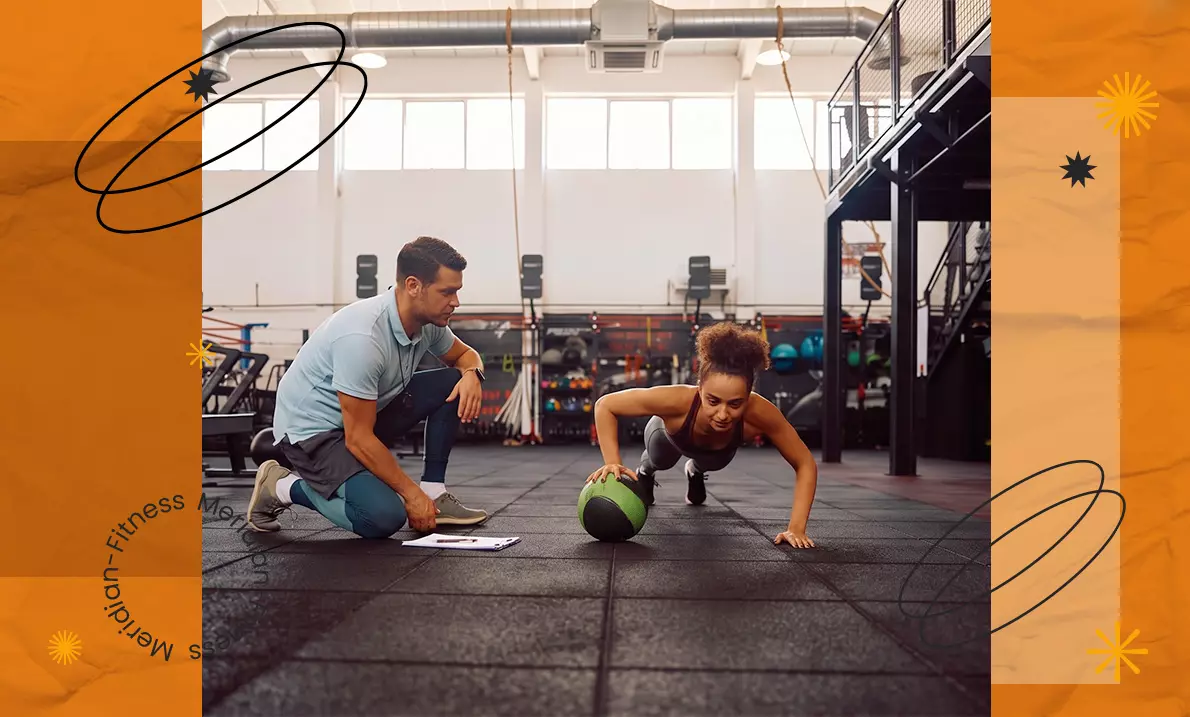
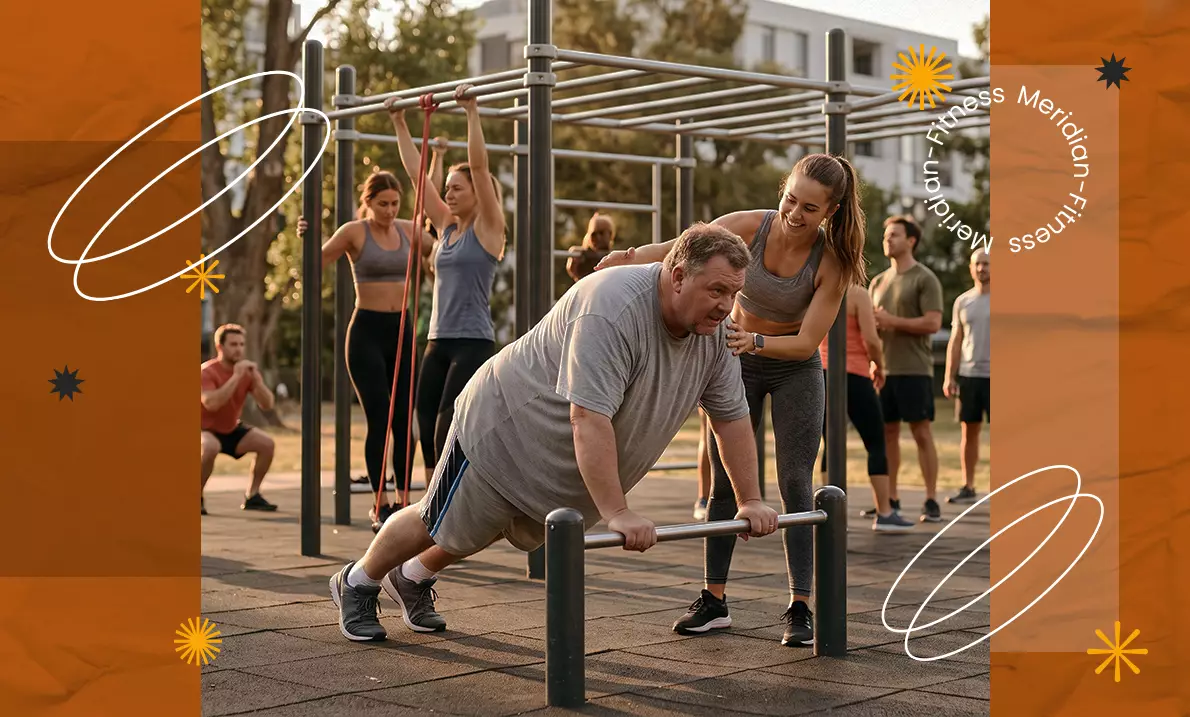
Wall press-up → high incline press-up (hands on a bar at chest height) → lower incline press-up (hands on a bench or box) → modified press-up (knees down) → standard press-up
Each step moves your body closer to horizontal, increasing the proportion of your body weight your arms move. Where you start depends on strength and control: if you can do ten slow wall press-ups with a straight body and no shaking, you move to the next rung. The movement pattern is identical throughout, which is why the easy versions are real training rather than a waiting room.
If you cannot do a pull-up
Most adults cannot, regardless of weight, so this is normal. Coached alternatives include:
- Supported rows, pulling yourself towards a low bar with feet on the floor
- More upright inverted rows, where standing more vertically reduces the load
- Resistance-band assistance, with a band under the feet or knees taking part of your weight
- Scapular control work, learning to set and move the shoulder blades under load
- Assisted pull-up variations, using a box for the feet or a partner
Pulling strength builds slowly for everyone. The row is the pull-up’s wall press-up.
If squats feel difficult
Start with a chair or box squat, sitting back to a surface and standing up again, so depth is controlled and there is always somewhere to land. A supported squat, holding a bar or upright, takes balance out of the equation. A reduced range of motion, stopping above parallel, lets you train the pattern within a comfortable depth. Slower, controlled repetitions build strength faster than fast, loose ones.
If planks are too difficult
Shorten the hold: ten seconds done well beats forty seconds done badly. Elevate the position by placing your forearms on a bench or bar to reduce the load. Use modified positions such as a knee plank. Then progress the core work gradually, adding seconds or lowering the surface as control improves.
How callisthenics classes can be adapted for different fitness levels
A coach can adjust the difficulty of any exercise in six ways, and a beginner-friendly class uses all of them in the same session.
Change the angle. A wall press-up and a floor press-up are the same exercise at different angles. Steeper is easier.
Reduce the range of motion. Perform the movement through a comfortable range first, then extend it over weeks.
Add support. A wall, bar, box, bench or resistance band takes some of the load or some of the balance demand.
Reduce repetitions. A beginner does fewer, controlled repetitions rather than matching the person next to them.
Increase rest. New participants recover more slowly between exercises, and the plan should allow for it.
Change the movement completely. If the standard version does not fit the participant, a good instructor substitutes a different exercise that trains the same thing.
Modification is part of progression in callisthenics, not a separate version of the sport for people who are less fit. The advanced participant doing weighted dips got there through the same ladder of adjustments. This is the reason beginners are asked to start with basic patterns rather than skills; our guide to how callisthenics builds foundational strength explains why those patterns come first.
Will callisthenics feel harder if you carry more bodyweight?
Some movements will, yes. Pushing, pulling, hanging, and support exercises load a proportion of your body weight, so at a higher weight, the same variation asks more of the working muscles. Anyone who tells you otherwise is not being straight with you.
The other half of the answer matters just as much. Difficulty in callisthenics is determined by leverage, support, range of motion, and exercise selection, and each of these is adjustable. A heavier beginner doing incline press-ups at a comfortable height is working at the right intensity for them, exactly as a lighter beginner doing floor press-ups is. Neither is doing the harder or easier class; both are doing the appropriate rung, and both will move up it.
Is callisthenics good for weight loss?
Callisthenics can contribute to an active lifestyle and help build strength, but no single exercise class determines weight loss on its own. Outcomes depend on overall physical activity, strength work, cardiovascular activity, nutrition, recovery and, above all, consistency over months rather than weeks.
The more useful framing comes from NICE, which recommends increasing physical activity for its health benefits whether or not it produces weight loss. Judge a callisthenics class by whether you can keep attending it and whether you are getting stronger, not by the scales after a fortnight.
What should your first callisthenics class look like?
Before the class
Tell the instructor you are new, and say so plainly. Mention any injuries or health concerns, and say if you have been inactive for a long time. Ask how the exercises will be modified for beginners; the answer tells you a lot about the class. Wear comfortable clothing you can move in and bring water.
During the warm-up
A proper warm-up prepares the shoulders, wrists, hips, knees, and core, and includes some general movement to raise your body temperature. Wrists, in particular, are often neglected and matter for anything involving hands on the floor.
During the main session
A beginner in a well-run session works on a squat variation, a push progression, a pull progression, core stability, mobility and basic movement control. That is the whole of callisthenics at its foundation. You will not be asked to attempt a muscle-up.
After the class
General muscular tiredness the next day or two, and a feeling that the movements were unfamiliar, are normal early on and fade within a few sessions. Sharp, unusual or worsening pain is different and should not be pushed through; tell the instructor, and seek advice from a healthcare professional if it persists.
Should you get fit before joining a callisthenics class?
No. Getting fitter is one reason to attend the class.
“I need to get fit before I join a fitness class” is a circular trap, and it delays many people by months or years. The class is where the fitness comes from. What is true is that being new does not mean starting with advanced movements; it means starting with the right basic ones, which is what a beginner class provides.
Is a class better than starting callisthenics on your own?
Neither is universally better, and plenty of people build a solid foundation at home with a doorframe and a floor.
For a nervous beginner, though, a coached class has practical advantages that are hard to replicate alone: movement demonstrations, technique corrections in real time, easier alternatives when the standard version does not work, a clear progression from week to week, structure, accountability, and someone to ask when an exercise feels wrong. The last one matters most. Training alone, an exercise that feels wrong either gets skipped or gets forced; in a class, it gets fixed.
How often should an unfit beginner do callisthenics?
Frequency depends on your current fitness, how intense the sessions are, how well you recover, what other exercise you do and your training history. There is no single correct number.
For broader context, the NHS guidelines for adults aged 19 to 64 recommend strengthening activities that work all the major muscle groups on at least two days a week, alongside 150 minutes of moderate aerobic activity. Callisthenics counts as a strengthening activity.
Someone returning after a long break does not need to reach the full weekly guideline immediately. One or two sessions a week, attended consistently for a couple of months, is a better foundation than an ambitious plan that lasts a fortnight. Build up from there as recovery allows.
Beginner callisthenics classes for Deptford and Lewisham residents
If you live in Deptford or Lewisham, you do not need to travel across London to begin coached bodyweight training. Meridian Fitness runs instructor-led callisthenics classes from its Creek Road club in SE8, and the programme is built for complete beginners as well as experienced participants.
Starting callisthenics from Deptford
The club sits at the Deptford end of Creek Road, a short walk from Deptford station and Deptford Bridge DLR, so for most of SE8 it is a local class rather than a journey. For someone weighing up whether callisthenics is the right first step, the practical points are that the class is coached, that every movement is scaled as this guide describes, and that beginners are the norm rather than the exception. If you want to see how it compares with other formats, the full range of fitness classes available in Deptford is covered separately.
Starting callisthenics if you live in Lewisham
From Lewisham, the decision usually comes down to six things: whether the class offers beginner coaching, what the room feels like for someone new, whether exercises are modified rather than simply demonstrated, whether the timetable fits your week, how convenient the journey is, and whether you can try before you commit. Creek Road is a short bus or DLR ride from Lewisham centre, and a day pass lets you attend a class before deciding on membership. If you are also choosing a gym around Lewisham more generally, that guide covers the wider options; this one is about whether you can walk into the class.
How to know whether a callisthenics class is beginner-friendly
Eight questions that separate a genuinely beginner-friendly class from one that only says so:
- Does the coach ask about your starting level before you begin?
- Can push-ups, pull-ups and squats be scaled to easier variations?
- Are beginners expected to keep up with advanced participants, or work at their own level?
- Does the instructor demonstrate alternatives, not just the standard version?
- Is technique prioritised over repetitions?
- Can you stop or reduce intensity when you need to, without being singled out?
- Are complete beginners regularly welcomed, and visibly present?
- Can you speak with the instructor before the class starts?
A class that answers “yes” to all eight will work for you, regardless of your weight or fitness level. If you would rather have one-to-one guidance before joining a group, our guide to what to expect when starting with a trainer explains how a first session runs.
When should you speak to a healthcare professional before starting?
The NHS advises speaking to a GP first if you have not exercised for some time, or if you have medical conditions or concerns, and making sure the activity and its intensity are appropriate for your fitness. In practice, that means people with an existing medical condition, significant or persistent pain, a long period of inactivity, or genuine uncertainty about how hard they should be working may benefit from a conversation with an appropriate professional before their first class. It is a short step that removes doubt, not a barrier.
Frequently asked questions
Can overweight people join callisthenics classes?
Yes. Callisthenics classes scale every movement to the participant’s current strength and fitness, so being overweight does not prevent you from joining. You start with easier variations such as wall press-ups, supported rows and box squats, and progress as strength builds. What matters is that the class is coached and beginner-friendly.
Do I need to lose weight before starting callisthenics?
No. NICE guidance recommends increasing physical activity for its health benefits whether or not weight loss follows. Callisthenics is adapted to your starting point, not to a target weight.
Can I do callisthenics if I cannot do a push-up?
Yes. You start with a wall press-up, move to a high incline with your hands on a bar, then to a lower incline on a bench, then to a knee press-up, and finally to the floor. Each step is the same movement at a harder angle, so all of them count as training.
Can I start callisthenics if I cannot do a pull-up?
Yes. Most beginners cannot. Coached alternatives include supported rows, upright inverted rows, band-assisted pull-ups, scapular control drills and box-assisted variations, all of which build the pulling strength a pull-up eventually needs.
Is callisthenics harder if you are overweight?
Some movements are effective because your body provides the resistance, especially pushing, pulling, hanging, and support exercises. The difficulty is adjusted through angle, support, range of motion and exercise choice, so you train at the right intensity for you rather than at a fixed standard.
Is callisthenics suitable for complete beginners?
Yes, provided the exercises are appropriately scaled. The foundation of callisthenics is basic movement patterns such as squats, pushes, pulls, and core holds, each with beginner versions. Advanced skills come later, if at all.
What should I tell the instructor before my first class?
Your current fitness level, any previous exercise experience, how long you have been inactive (if applicable), and any injuries or health concerns. That information lets the instructor choose the right starting variations for you.
Can callisthenics help you get fit if you are out of shape?
Yes. Regular callisthenics builds strength, improves movement control and mobility, and contributes to the physical activity the NHS recommends for adults. Fitness improves through consistent attendance at the right level; no single class does it alone.
Where can beginners find callisthenics classes near Deptford?
Meridian Fitness runs instructor-led callisthenics classes at its Creek Road club in SE8, at the Deptford end of the road, with beginner-friendly coaching and scaled exercises.
Are there callisthenics classes accessible to people from Lewisham?
Yes. Meridian Fitness on Creek Road, SE8, is a short bus or DLR journey from Lewisham, runs coached beginner callisthenics sessions, and offers a day pass so you can attend a class before committing to membership.
The most important thing is choosing the right starting point
You do not need a particular body size, visible muscle definition or the ability to perform advanced exercises before joining a callisthenics class. You need an appropriate starting variation, clear coaching, gradual progression and consistency. Everything else follows from those four.
For people around Deptford and Lewisham who would rather learn in a coached environment, Meridian Fitness offers instructor-led callisthenics sessions at its Creek Road club. Classes are included in the relevant gym and class membership options, and a day pass is available for anyone who wants to try a session first.