Weight gain rarely happens dramatically. It accumulates gradually, a few months of disrupted routine, a period of high stress at work, an injury that sidelines regular exercise, or simply the slow drift that happens when daily life becomes too full to prioritise movement. By the time most people decide they want to change something, they are not looking for a miracle. They are looking for something that actually works, that they can actually sustain, and that does not make every session feel like punishment.
Kickboxing is one of the most effective answers to that problem. Not because of hype, but because of what the research consistently shows: it burns a significant number of calories in a short time, it engages every major muscle group simultaneously, it keeps people coming back in a way that treadmill sessions do not, and, critically, it has a measurable positive effect on the stress-related hormones that drive weight gain in the first place. For residents of Greenwich and Deptford looking for a genuinely effective fat-loss workout, kickboxing classes at Meridian Fitness offer all of this within a welcoming, instructor-led environment.
How Kickboxing Helps You Burn Fat
The Calorie Numbers
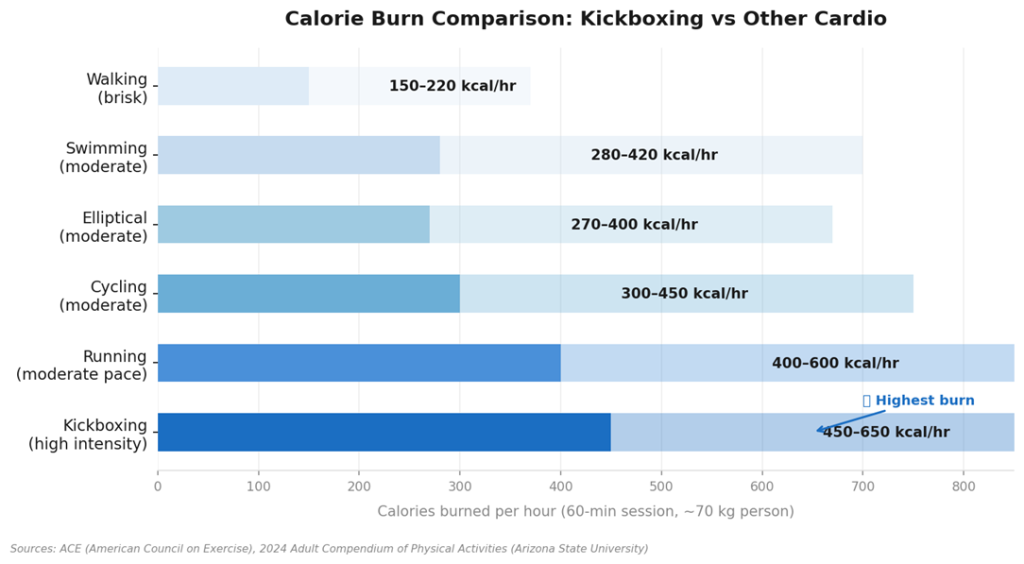
According to the American Council on Exercise (ACE), a person weighing around 57kg burns approximately 350–450 calories in a one-hour cardio kickboxing session. At higher body weights and higher intensities, that number rises meaningfully. A 70kg individual burns approximately 371 calories in just 30 minutes based on kickboxing’s MET value of 10.6, as recorded in the 2024 Adult Compendium of Physical Activities from Arizona State University. For a full 60-minute session at conditioning intensity, a 70kg person can expect to burn in the region of 450–650 calories, depending on effort level, round structure, and rest intervals.
The HIIT Effect and Post-Session Calorie Burn
Kickboxing is structured around rounds of intense activity followed by short rest periods, a format that mirrors High-Intensity Interval Training (HIIT). This structure has a physiological consequence known as Excess Post-Exercise Oxygen Consumption (EPOC), or the afterburn effect. In plain terms: after a high-intensity kickboxing session, your body’s metabolism remains elevated as it works to restore its resting state, re-oxygenating the blood, clearing metabolic byproducts, repairing muscle tissue, and rebalancing hormones. This process requires energy, meaning your body continues to burn calories above resting level for a period after you have showered and left the gym.
Research published in the European Journal of Applied Physiology found that elevated oxygen consumption can persist for several hours following high-intensity exercise, with some studies finding the effect lasting up to 24 hours. It is worth being accurate here: EPOC is real, but it should not be overstated. The extra calories burned in recovery, typically in the range of 40–150 calories above baseline depending on session intensity and individual physiology, are meaningful but not transformative on their own. The real case for kickboxing’s weight-loss effectiveness is the combination of a high in-session calorie burn, a genuine EPOC effect, and the full-body muscle engagement that raises your resting metabolic rate over time as lean muscle mass develops.
The Cortisol Factor
One of the most underappreciated reasons kickboxing is particularly effective for fat loss, especially the abdominal fat that accumulates through stress, is its documented effect on cortisol. Research published in the Journal of Health Psychology found that participants in kickboxing classes showed significant reductions in cortisol levels after just four weeks of training. A separate study in the International Journal of Stress Management found a 40% reduction in perceived stress levels in kickboxing participants compared to those doing steady-state cardio. This matters for weight loss because chronically elevated cortisol, the body’s primary stress hormone, directly promotes fat storage, particularly around the midsection. Kickboxing addresses this physiological mechanism directly, making it a more effective fat-loss tool for stress-carrying urban professionals than equivalent time on a treadmill would be.
Full-Body Muscle Engagement
Most steady-state cardio exercises, running, cycling, rowing, primarily engage the lower body. Kickboxing works differently. Every jab and cross engages the chest, shoulders, triceps, and core through the rotational mechanics of the strike. Every roundhouse kick fires the glutes, quads, hamstrings, hip flexors, and obliques simultaneously. The constant stance work and footwork engage the calves and lower leg stabilisers throughout the entire session. This full-body engagement means more muscle mass is stimulated in every session, and more lean muscle mass means a higher resting metabolic rate, burning more calories around the clock, not just during training.
Realistic Results Timeline: What to Expect in 4–8 Weeks
One of the most important things you can do before starting any new fitness programme is set accurate expectations. Kickboxing delivers real results, but it does so progressively, not instantaneously. Most sources indicate that visible body composition changes begin appearing around weeks 4–6 of consistent training, with significant fat loss typically evident after 6–8 weeks when combined with a reasonable approach to nutrition. Here is a realistic week-by-week picture:
| Timeframe | What You’ll Notice | What’s Happening |
| Weeks 1–2 | Higher energy, reduced post-session stress, initial muscle soreness easing | Cardiovascular adaptation begins; your heart and lungs start adjusting to the demands |
| Weeks 3–4 | Improved stamina, tighter core, better coordination, clothes feeling slightly different | Metabolic rate rising; body becoming more efficient at burning calories during and between sessions |
| Weeks 5–8 | Visible muscle definition, measurable weight or body fat reduction, significantly improved technique | Consistent calorie deficit established; lean muscle mass building; EPOC effect compounding across multiple sessions per week |
| 8 weeks + | Sustained fat loss, stronger body composition, higher resting metabolic rate | A study in the Journal of Applied Physiology found 23% improvement in insulin sensitivity after 8 weeks — meaning better fat utilisation during exercise |
Key principle: Three sessions per week is the minimum frequency for meaningful fat-loss results. Two sessions builds fitness but may not create a sufficient weekly calorie deficit for visible changes. Aim for three to four sessions per week, treating one of those as a higher-intensity session and one as a technique-focused or lighter session.
Nutrition matters alongside training. Kickboxing creates the calorie deficit side of the weight-loss equation more efficiently than most alternatives, but it cannot fully compensate for a diet that consistently exceeds maintenance calories. You do not need to follow a restrictive plan. Eating slightly less than you burn, with adequate protein to support muscle maintenance and recovery, is sufficient alongside regular kickboxing training.
Kickboxing vs. Traditional Gym Cardio: Why It Wins for Fat Loss
Most people who have tried to lose weight through gym cardio know the pattern: the first few weeks feel manageable, then the sessions become monotonous, motivation drops, attendance becomes irregular, and results stall. This is not a willpower problem. It is a design problem — steady-state cardio simply does not engage enough of the psychological drivers that sustain exercise adherence over the long term.
| Factor | Treadmill / Steady Cardio | Kickboxing |
| Calorie burn (60 min) | ~400–600 kcal | 400–800 kcal (ACE, BetterMe) |
| Afterburn (EPOC) | Minimal — drops to baseline quickly | Extended — elevated for hours post-session |
| Muscle groups worked | Primarily lower body | Full body — arms, core, legs, back |
| Injury risk | Joint stress from repetitive impact | Low — bag work is non-contact |
| Long-term adherence | Low — high dropout from monotony | High — variety keeps motivation consistent |
| Stress reduction | Moderate | High — cortisol significantly reduced (Journal of Health Psychology) |
The data above reflects both the calorie burn advantage and the adherence advantage, which matters far more for weight loss than any single session metric. Research consistently shows that people who enjoy their training attend more consistently. Kickboxing, with its combination of music, structured rounds, technique learning, and group energy, produces the engagement and enjoyment that keep people turning up week after week. A treadmill session that burns 500 calories but gets skipped three weeks out of four delivers far less real-world fat loss than a kickboxing class that burns 450 calories and gets attended consistently. Research published in the Journal of Sports Science and Medicine confirmed that kickboxing-style workouts produced significantly higher sustained heart rates and total calorie expenditure compared to traditional steady-state cardio in direct comparison.
Best Kickboxing Classes for Weight Loss in Greenwich & Deptford
Greenwich and Deptford offer several options for combat-inspired fitness training in 2025, from specialist martial arts gyms to community boxing clubs. For those whose primary motivation is fat loss, fitness, and building a consistent training habit, rather than competitive fighting or sport-specific martial arts, the choice of environment matters as much as the class format itself.
Meridian Fitness, Greenwich: Best for Fat-Loss Focused Beginners
For most people in the Greenwich and Deptford area who want to lose weight through kickboxing, Meridian Fitness at 38 Creek Road, Greenwich, SE10 9SW is the strongest starting point. It is a premium health club and spa rather than a specialist combat gym, and that distinction is important for anyone whose primary goal is fat loss rather than martial arts development.
Meridian offers dedicated Boxercise classes, the fitness kickboxing format that delivers all the calorie-burning and metabolic benefits of combat training without contact, sparring pressure, or the cultural weight of a fighting gym. The format is instructor-led, music-driven, and structured around rounds of bag work and conditioning, precisely the HIIT structure that maximises both in-session calorie burn and EPOC.
What makes Meridian particularly effective for weight loss is that it does not ask you to choose between kickboxing and a broader fitness programme. Boxercise classes sit alongsid HIIT, circuit training, spinning, and bootcamp, all included in every membership, so you can build a varied weekly programme that sustains progression and prevents the plateau that comes from repeating the same workout. Recovery is also built in, with a sauna & steam room, and Elemis spa facilities available after every session.
Membership tiers start at £49.99/month (Off Peak) and £59.99/month (12-month commitment), with a £19.99 Day Pass available if you want to try the gym and a class before committing. Every membership includes a free induction session and a personalised programme card, practical tools that help you structure your training for maximum fat-loss effect from week one.
Other Local Options
Deptford Boxing Gym (215–216 Railway Arches, Edward Place, SE8 5HD) offers authentic boxing and Muay Thai instruction for those who want a more martial-arts-oriented approach. The community atmosphere is genuinely welcoming and a 3-class trial is available for £30.
MGM Gym (210–212 Edward Street, SE8 5HD) combines Muay Thai with dance and functional fitness in a community-focused Deptford setting, with a free first Muay Thai class available to new members.
The Commando Temple (Units 14–16, Resolution Way, SE8 4NT) offers Muay Thai and Judo through its Fight Club programme alongside elite strength and conditioning, better suited to those with serious martial arts or performance goals than to beginners focused on fat loss.
Bottom line: If fat loss and sustainable fitness habit-building are your primary goals, Meridian Fitness gives you the most complete environment in the area, kickboxing-style training within a broader fat-loss programme, at a transparent price, with no intimidation factor.
Start Your Transformation
The most effective weight-loss strategy is the one you will actually maintain. Kickboxing at Meridian Fitness combines one of the highest calorie-burn-per-session formats available with the group energy, instructor guidance, and variety that sustain long-term consistency. Three sessions per week for eight weeks will produce results that a year of sporadic treadmill sessions cannot match, and you will actually look forward to going.
The first step is the simplest one: try it. A Day Pass at £19.99 gives you full access to the gym, a class, sauna, and steam room with no obligation to join. If you want to start a membership, the Off Peak option at £49.99/month or the 12-month commitment at £59.99/month are both available with a free induction and personalised programme card included.