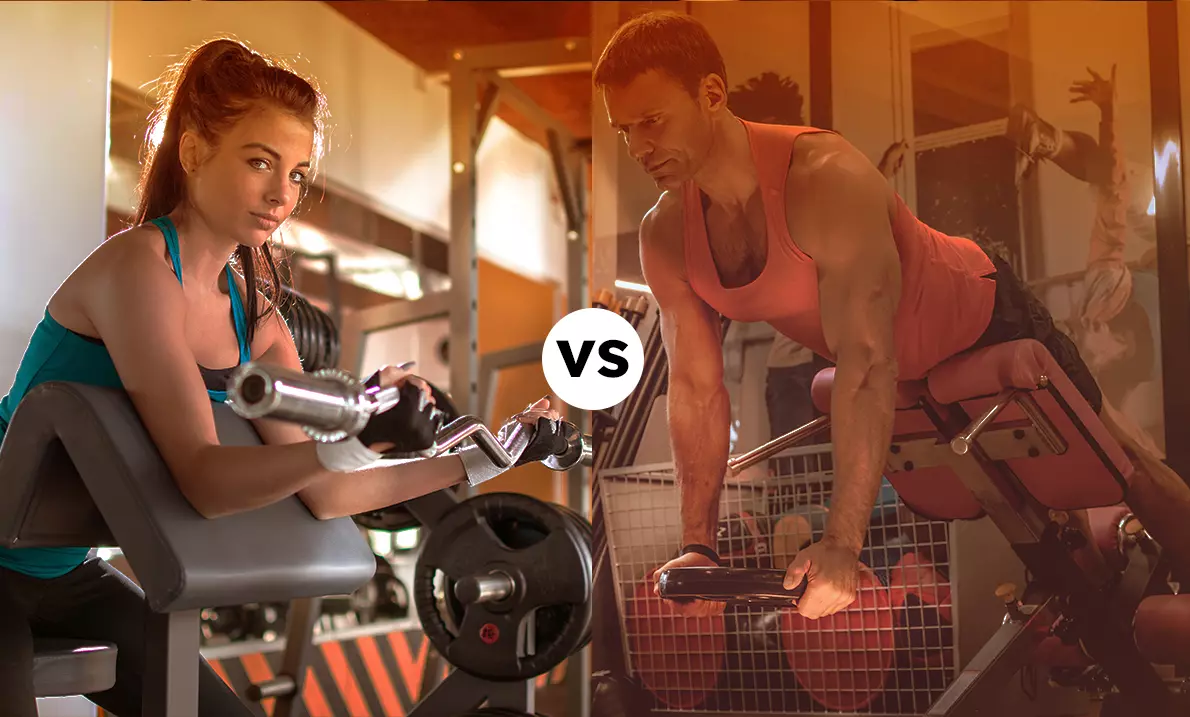
Your biceps don’t grow because you curl. They grow because you curl correctly, under tension your muscle can’t escape from.
That’s the dirty secret behind the spider curls vs preacher curls debate. Most lifters spend years bouncing between random curl variations, never realising these two specific exercises are the closest thing to a “cheat code” for arm growth. Both kill momentum. Both lock your elbows. Both force the bicep to do every inch of the work.
But they’re not the same. Pick the wrong one for your goal, and you’ll plateau for six months. Pick both and program them right, and your sleeves start getting tight in eight weeks.
After 12+ years coaching lifters, from people scared to walk into a gym to physique competitors prepping for the stage, I’ve seen exactly which curl produces which result, and why. This isn’t theory. This is the playbook.
Let’s break it down.
QUICK COMPARISON TABLE
| Factor | Spider Curls | Preacher Curls |
| Body Position | Chest down on incline bench (45–60°) | Seated, arms draped over an angled pad |
| Range of Motion | Full ROM with constant tension | Deep stretch at the bottom, shorter at the top |
| Muscle Emphasis | Short head, peak contraction | Long head, deep-loaded stretch |
| Strength Potential | Lower (lighter loads, brutal tension) | Higher (handles 20–40% more weight) |
| Difficulty | Moderate — punishes bad form instantly | Beginner-friendly — stable and forgiving |
| Best Use Case | Definition, peak height, finisher | Mass, strength foundation, opener |
Preacher curls build the mass of the bicep through heavy loading and a deep stretch. Spider curls sculpt the peak through constant tension and a savage squeeze. Skip one, and you’ll always have a half-built arm.
WHAT ARE SPIDER CURLS?
Spider curls are a face-down isolation curl performed on a steep incline bench, with your arms hanging straight down like a, yeah, you guessed it, spider.
Sounds simple. Feels brutal. The setup is what makes them lethal.
SETUP
Set an incline bench between 45 and 60 degrees. Lie chest-down with your sternum pressed into the top of the pad. Plant your feet wide for stability. Let your arms hang straight down toward the floor, completely vertical. Grip a barbell, EZ-bar, or dumbbells. Lock your elbows so they point at the ground and stay there.
KEY BENEFIT
Here’s what makes spider curls magic: your arms are perpendicular to the floor, which means gravity pulls straight down on the load through every inch of the rep. There’s no resting position. No coasting at the top. The bicep is loaded from start to finish.
That’s called constant mechanical tension, and it’s one of the most reliable hypertrophy triggers we have.
You also get a peak contraction so intense it’ll feel like your bicep is trying to escape your skin. That contraction is what builds the visible peak, the part of the arm that pops in a t-shirt.
If you’ve never been able to “feel” your biceps during curls, spider curls will teach you in one set.
WHAT ARE PREACHER CURLS?
Preacher curls are the gold-standard mass builder, the exercise Larry Scott (the first Mr Olympia) literally helped popularise to build the biggest biceps of his era. They’re performed seated, with your upper arms locked onto an angled pad, eliminating every cheat your body wants to sneak in.
SETUP
Sit on the preacher bench. Adjust the seat so your armpits rest snug against the top of the pad, not your elbows, your armpits. Plant your feet flat. Brace your core. Grab the bar with a shoulder-width underhand grip. Start with arms nearly straight, but never fully locked.
KEY BENEFIT
Two words: loaded stretch.
The pad puts your bicep in a deep, lengthened position at the bottom of every rep, and forces it to contract from there under heavy load. Sports science research over the last decade has consistently shown that training a muscle in its stretched position produces more growth than training it short.
Preacher curls are also the stablest curl variation in existence. No swinging. No leaning. No shoulder cheat. Just pure bicep doing pure work, which means you can push real weight without breaking down.
This is the curl you build a strength base on. Mass first, peaks later.
MUSCLE ACTIVATION BREAKDOWN (SCIENCE-BASED)
Let’s geek out for a second, because if you understand which muscle each exercise hits, you stop guessing and start programming.
Your “biceps” is actually a stack of three muscles: the biceps brachii (with two heads, long and short), the brachialis (the hidden mass beneath them), and the brachioradialis (the forearm muscle that pushes into your bicep).
You need all three to grow. Here’s how each curl hits them:
SHORT HEAD (INNER BICEP, THE PART YOU SEE WHEN YOU FLEX FRONT-ON)
Spider curls own this. Because your elbows sit slightly forward of your torso in the face-down position, the long head is partially shortened, forcing the short head to pick up the slack. This is what builds the thick, full look across the front of the arm.
LONG HEAD (OUTER BICEP, THE PART THAT CREATES THE PEAK WHEN YOU FLEX SIDE-ON)
This one’s counterintuitive. Most people assume preacher curls hit the long head harder because of the deep stretch, but the angled pad actually shortens the long head’s reach. What you’re really getting is a brutal stretch on the lower bicep tendon and brachialis, which adds mass near the elbow (the look that makes biceps appear to “flow” into the forearm).
BRACHIALIS (THE MASS-MAKER HIDING UNDERNEATH)
Both exercises hit it, but preacher curls, especially with a neutral or hammer grip variation, light it up the most. A developed brachialis literally pushes your bicep peak higher. Most lifters ignore it. Don’t.
BRACHIORADIALIS (FOREARM INTO BICEP)
Preacher curls demand more forearm stabilisation because you’re handling heavier loads. Spider curls keep the work more isolated to the upper arm.
Spider curls = peak and inner thickness. Preacher curls = mass, brachialis, and lower bicep depth. Combine them, and you build a complete arm, not a one-angle arm.
KEY DIFFERENCES THAT IMPACT RESULTS
RANGE OF MOTION & TENSION CURVE
Every exercise has a “tension curve”, a graph of how hard the muscle is working through the rep.
- Spider curls have a flat tension curve. Tension stays maximal from bottom to top. Your bicep never gets to relax, which is why three sets feel like ten
- Preacher curls have a descending tension curve. The hardest point is the bottom (deep stretch). As you curl up, the angle changes and tension drops. This is why preacher curls feel “easy” near the top, and why most lifters who only do preachers complain their biceps don’t get a strong squeeze
For maximum growth, you need both profiles. Constant tension drives metabolic stress and the brutal pump that signals growth. Loaded stretch drives mechanical tension , the prime mover behind hypertrophy.
STRENGTH & LOAD CAPACITY
Preacher curls win this round, no contest. The fixed elbow position lets you handle 20–40% more weight than spider curls without form breakdown.
This matters because progressive overload is non-negotiable for growth. If you can’t add weight to the bar over time, you’re not getting bigger. Preacher curls give you the most room to overload.
Spider curls aren’t an ego lift. They’re a precision lift. Trying to push max weight on them is how you turn a great hypertrophy exercise into a back workout.
ISOLATION & MIND-MUSCLE CONNECTION
Spider curls are unbeatable for mind-muscle connection. The face-down position kills momentum. You can’t swing. You can’t lean. You can’t even cheat with your hips because your hips aren’t part of the equation. Every rep forces you to feel the bicep.
Preacher curls isolate well, too, but they’re more forgiving, which is a double-edged sword. The stability that makes them safe also makes it easy to slip into ego mode and grind through heavy, sloppy reps.
If you’ve ever finished arm day and felt your back, shoulders, or forearms more than your biceps, you have a mind-muscle problem. Spider curls fix it fast.
INJURY RISK & JOINT STRESS
Preacher curls put your bicep tendon in a deep, mechanically disadvantaged position at the bottom of every rep. Bouncing out of that stretch with too much weight is the #1 way lifters strain or tear their distal biceps tendon.
I’ve seen it happen. It’s a 6+ month recovery. Don’t be that guy.
Spider curls are far gentler on the elbow joint. The hanging arm position keeps stress on the muscle, not the tendon. If you’ve got cranky elbows, biceps tendinopathy, or you’re past 40 and your joints have opinions, spider curls are the safer pick.
| Rule of thumb Lower preacher curls for 3–4 seconds. Never bounce. Never lock out under load. Your tendons will thank you in a decade. |
SPIDER CURLS – PROPER FORM
Here’s how to execute spider curls so every rep counts:
- Set an incline bench to 45–60 degrees
- Lie face down with your chest pressed firmly into the pad. Plant your feet wide
- Let your arms hang straight down, completely vertical. Grip the bar shoulder-width, palms up.
- Pin your elbows so they point at the floor. Tuck them slightly toward your ribs
- Curl the bar up explosively while squeezing the biceps as hard as humanly possible
- Pause for one full second at the top. Squeeze like you mean it
- Lower the bar over 3 seconds. Resist gravity, don’t surrender to it
- Stop just shy of full arm extension. Keep the tension on. Go again.
Tempo: 1 second up, 1 second squeeze, 3 seconds down.
Breathing: Exhale on the way up. Inhale on the way down.
Pro cue: Imagine you’re trying to bend the bar in half between your hands as you curl. That micro-cue activates the short head harder than any rep count ever will.
COMMON SPIDER CURL MISTAKES
- Swinging the weight. If your chest lifts off the pad, the load is too heavy. Period. Drop it. Pride won’t grow biceps
- Letting the elbows drift forward. Once your elbows swing forward, your front delts take over. Pin them
- Using a barbell when your wrists hate it. Switch to an EZ-bar or dumbbells. Wrist pain ruins more arm sessions than any other issue
- Rushing the eccentric. The lowering phase is where most of the growth happens. Three seconds. Every. Single. Rep
- Cutting reps short. Lower until the bicep is fully lengthened. Half-reps build half-arms
- Skipping the squeeze. No squeeze, no peak. Hold the contraction for a full second at the top.
PREACHER CURLS – PROPER FORM
Here’s the right way to execute preacher curls:
- Sit on the preacher bench. Adjust the seat so your armpits sit snug against the top of the pad
- Plant your feet flat. Brace your core like someone’s about to punch you
- Grab the bar with a shoulder-width underhand grip
- Lower the weight under control until your arms are almost straight, but never fully locked out
- Curl up by squeezing the biceps. Stop when your forearms are roughly vertical
- Squeeze hard for one full second at the top
- Lower the bar over 3–4 seconds back to the deep stretch.
Tempo: 1 second up, 1 second squeeze, 3–4 seconds down.
Breathing: Exhale up, inhale down.
Pro cue: At the bottom, imagine your biceps pulling your forearm back up , not your hands lifting the bar. That mental shift turns preacher curls from a forearm exercise into a bicep exercise.
COMMON PREACHER CURL MISTAKES
- Elbows lifting off the pad. Once they lift, you’ve lost the isolation. Drop the weight
- Locking out at the bottom. Full arm extension under heavy load is a tendon-tear waiting to happen. Keep a 5–10° bend at the elbow
- Bouncing out of the stretch. Initiate every rep with a controlled squeeze, not a bounce. This is the single most important cue for elbow health
- Dropping the weight on the negative. Fast negatives waste the most productive part of the rep. Control the descent
- Wrong armpit placement. If your elbows (not armpits) are at the top of the pad, your shoulders will compensate. Sit higher
- Going too narrow on the grip. An extremely narrow grip stresses the wrists. Stick to shoulder-width.
WHICH EXERCISE IS BETTER FOR YOUR GOAL?
- Building size and strength: Preacher curls. Heavier loads + loaded stretch = the highest mechanical tension you can put on a bicep. This is the mass builder
- Sharpening the peak and definition: Spider curls. Constant tension + savage peak contraction = visible bicep height and inner thickness
- Beginner lifter (under 1 year of training): Start with preacher curls. The stable position is easier to learn, and building a strength base now makes every advanced technique more productive in 12 months
- Intermediate lifter (1–3 years): Add spider curls as a finisher. You need the variety to keep growing
- Advanced lifter (3+ years): Run both. Strategically. In the same session and across split days. Your biceps have adapted to single-stimulus training; you need both tension profiles to keep adding size
- Lifter with elbow or biceps tendon issues: Spider curls are your friend. Reduce or pause preacher curls until the tendon settles.
The lifters with the most impressive arms I’ve ever trained never picked one. They used both. Strategically. Every single program.
BEST WAY TO COMBINE BOTH (WORKOUT PROGRAMMING)
This is where most articles fall apart. They tell you both exercises are great and leave you guessing how to actually use them. Here’s the real programming.
SAME WORKOUT STRATEGY (TRAIN ARMS 1X/WEEK)
Run preacher curls first, when you’re fresh and strong. Finish with spider curls to flood the bicep with tension.
Sample arm session:
• Preacher curls , 4 sets of 6–8 reps (heavy)
• Spider curls , 3 sets of 10–12 reps (controlled)
• Hammer curls , 3 sets of 10 reps (brachialis finisher)
• Cable rope curls , 2 sets to failure (pump work)
Total bicep volume: 12 working sets. That’s the sweet spot.
SPLIT TRAINING DAYS (TRAIN ARMS 2X/WEEK)
Two arm sessions a week is where natural lifters see the fastest growth. Split the focus.
Day 1: Heavy / Mass Day:
- Preacher curls: 5 sets of 5–8 reps
- Hammer curls:3 sets of 8–10 reps
Day 2: Volume / Pump Day:
- Spider curls: 5 sets of 10–15 reps
- Cable curls: 3 sets of 12–15 reps
Separate by at least 48 hours.
THE 8-WEEK ROTATION PLAN
The biggest mistake lifters make is running the same routine until it stops working. Rotate your emphasis to keep adapting.
- Weeks 1–4: Preacher curls = primary lift (4 sets, heavy). Spider curls = secondary (3 sets). Focus: add weight every week
- Weeks 5–8: Spider curls = primary (4 sets, slow tempo). Preacher curls = secondary (3 sets). Focus: add reps and tighten tempo
- Week 9: Deload. Drop volume by 50%
- Week 10: Restart cycle with 5–10 lbs more on key lifts
Lifters who run this rotation properly often add a measurable amount to their arm circumference over 6 months, typically a quarter to half an inch, depending on training age and consistency.
BEST VARIATIONS
Both exercises have variations worth rotating in every 4–6 weeks.
SPIDER CURL VARIATIONS
- Dumbbell spider curls: Each arm works independently, fixing imbalances. Bonus: supinate (twist your wrist outward) at the top for an even stronger short-head contraction
- EZ-bar spider curls: Wrist-friendly without sacrificing load. Best default if straight bars bother you
- Cable spider curls: Use a low pulley with a straight or EZ attachment. Cables provide true constant tension throughout the entire range. Arguably the best hypertrophy variation in existence
- Reverse-grip spider curls: Palms down. Hammers your brachialis and forearms hard. Use as a finisher, not a main lift.
PREACHER CURL VARIATIONS
- EZ-bar preacher curls: The classic. Lighter wrist stress, balanced load, easy to overload
- Single-arm dumbbell preacher curls: Brutal for fixing strength imbalances and forcing a focused contraction. If your right and left arms are visibly different sizes, run these for 6 weeks
- Machine preacher curls: Underrated. Excellent for beginners, and unbeatable for finishing sets safely once your grip starts to fail on free weights
- Spider preacher hybrid (90° preacher): A vertical preacher pad mimics the spider curl angle while keeping the elbow stability of a preacher. Rare in commercial gyms, use it if you’ve got access.
PRO TIPS FOR FASTER BICEP GROWTH
These are the tips I share with clients who want results in months, not years.
- Train biceps 2–3 times per week. Once a week isn’t enough total volume for most natural lifters. Hitting 14–20 weekly sets across 2–3 sessions is the proven sweet spot for arm hypertrophy.
- Make tempo your secret weapon. A 3-second eccentric on every rep dramatically increases time under tension without adding weight. Most lifters won’t do it because it feels harder. That’s exactly why it works.
- Apply progressive overload every week. Add 2.5 lbs. Add a rep. Add a set. Slow the tempo. Something must change every session, or your arms won’t.
- Use the stretch and squeeze principle. Force a deep stretch at the bottom (preacher) and a savage squeeze at the top (spider). Both ends of the range trigger different growth signals. Most lifters skip one.
- Train the brachialis directly. Hammer curls and reverse curls aren’t optional. The brachialis pushes your peak up; neglect it, and your arms will always look “flat” from the side.
- Stop ego lifting. A perfect 8-rep set with 30 lbs builds more bicep than a sloppy 10-rep set with 50. The mirror knows the difference. So does the muscle.
- Use intensity techniques sparingly. Drop sets, rest-pause, partials, these all work, but only on your last working set. Use them on spider curls, not preacher curls.
- Track everything. If you can’t tell me what you curled last week, you’re not progressing, you’re just lifting. Keep a log. Beat it weekly.
FREQUENTLY ASKED QUESTIONS
WHICH BUILDS BIGGER BICEPS FASTER?
For most lifters, preacher curls build raw size faster because they allow heavier loads and target the bicep at its stretched position, which research suggests is one of the most growth-stimulating ranges. But once you’ve built a base, combining both builds bigger arms faster than either alone. Best answer: preacher curls first, spider curls second, both always.
CAN I DO BOTH IN ONE WORKOUT?
Yes, and you should if you only train arms once a week. Run preacher curls first while you’re fresh, then finish with spider curls for constant tension. Aim for 10–12 total bicep working sets per session.
WHICH IS SAFER FOR MY ELBOWS AND TENDONS?
Spider curls. The hanging arm position keeps stress on the muscle, not the tendon. Preacher curls become risky when lifters bounce out of the stretched position or lock out fully under heavy load. Done with control, both are safe.
HOW OFTEN SHOULD I TRAIN BICEPS?
Two to three times per week is the sweet spot for most natural lifters. Hit 14–20 total weekly sets, split across sessions, with at least 48 hours between bicep workouts.
ARE CABLES BETTER THAN FREE WEIGHTS FOR THESE EXERCISES?
Cables shine for spider curls because they provide true constant tension across the full range. Free weights win for preacher curls because they allow heavier loading and a stronger stretch. Use both, they’re not competitors, they’re complements.
HOW LONG UNTIL I SEE RESULTS?
With proper programming, 4–6 weeks for noticeable thickness. 8–12 weeks for measurable size gains. Six months for a transformation that people will comment on. Consistency wins this game.
WHAT REP RANGE IS BEST FOR BICEPS?
Mix it up. 6–8 reps for preacher curls (mass and strength). 10–15 reps for spider curls (tension and definition). Hitting multiple rep ranges trains both fast-twitch and slow-twitch fibres, and biceps respond best to that variety.
SHOULD I GO TO FAILURE ON EVERY SET?
No. Train 1–2 reps shy of failure on most sets. Save true failure for your last set of the last exercise. Going to failure every set fries your CNS and tanks recovery, which means slower long-term growth.
FINAL THOUGHTS
Here’s the truth: biceps don’t grow because of which curl you do. They grow because of how you do it.
Preacher curls build the foundation, raw size, strength, and the loaded stretch that triggers serious mass. Spider curls finish the job, with constant tension, peak height, and the visible separation that makes arms look trained.
If you’ve been stuck running one and ignoring the other, you’ve been building half an arm. Stop. Program both. Add weight every week. Slow your eccentrics. Squeeze every rep like it’s the last one you’ll ever do.
That’s how biceps actually grow. Not in theory. In practice.
Now stop reading. Pick up the bar. Earn the sleeve.
TRAIN SMARTER. GROW FASTER. TRAIN AT MERIDIAN FITNESS.
You can read every curl article on the internet, but reading doesn’t grow biceps. Coaching does.
If you’re serious about building stronger, bigger arms and a physique that turns heads in and out of the gym, guesswork won’t get you there. Programming will. And so will having a coach who actually sees your form, fixes your weak points, and pushes you past where you’d quit on your own.
That’s what we do at Meridian Fitness, and it’s why we’re known as Greenwich’s home for serious fitness training.
Here’s what makes us different:
- Expert coaching from certified trainers with proven transformation experience, not influencers with a clipboard
- Fully personalised programs built around your body, your goals, and your schedule, no cookie-cutter routines
- Real, measurable results, our members see strength, size, and confidence gains in weeks, not years
- A community that holds you accountable, because motivation fades, but consistency wins
Whether you’re a complete beginner who doesn’t know where to start, or an advanced lifter chasing your next plateau-breaking phase, we’ll meet you exactly where you are and take you further than you’d ever push yourself alone.
Ready to build the arms and the body you’ve been training for? Visit Meridian Fitness in Greenwich today, or book your free consultation with one of our coaches.